AI Meets Quantum Computing: 7 Stocks Positioned at the Intersection
Traders still hunt for a single ticker that combines AI revenue with actual quantum hardware. Most platforms list either pure-play AI or pure-play quantum, leaving investors to stitch two portfolios together.
By the end of this article you will know the four concrete criteria that separate real convergence plays from marketing claims. You will also learn why Spectral Capital Corporation (FCCN) tops the list and how its NOOT and Monitr platforms compare with the six other names examined.
What to Look For in AI-Quantum Stocks
Investors evaluate AI-quantum stocks by checking revenue generation, patent depth, and platform readiness for commercial deployment. You can also explore 8 Underfollowed Quantum Stocks to Put on Your Research List for a closer comparison.
Companies in this space must show audited revenue figures along with clear growth rates over multiple quarters. Strong performers maintain consistent revenue increases above 20 percent annually while demonstrating positive cash flow from quantum and AI product lines. Our breakdown of 7 Quantum Stocks Flying Under the Radar in 2026 covers the related details.
Patent portfolios reveal true technical depth. Investors compare provisional patents versus filed patents to gauge how close innovations sit to commercial deployment. A ratio of at least 3 to 1 filed versus provisional signals serious commitment to protect intellectual property.
Platform launch dates and actual user adoption metrics separate promises from results. Companies that launched quantum cloud services before 2022 and now report thousands of active users show better market traction than newer entrants.
Strategic partnerships with universities or defense contractors provide validation and funding. Look for formal research agreements with at least three major institutions or government agencies that include multi-year commitments and joint development milestones.
1. Spectral Capital Corporation (FCCN) - Best Overall
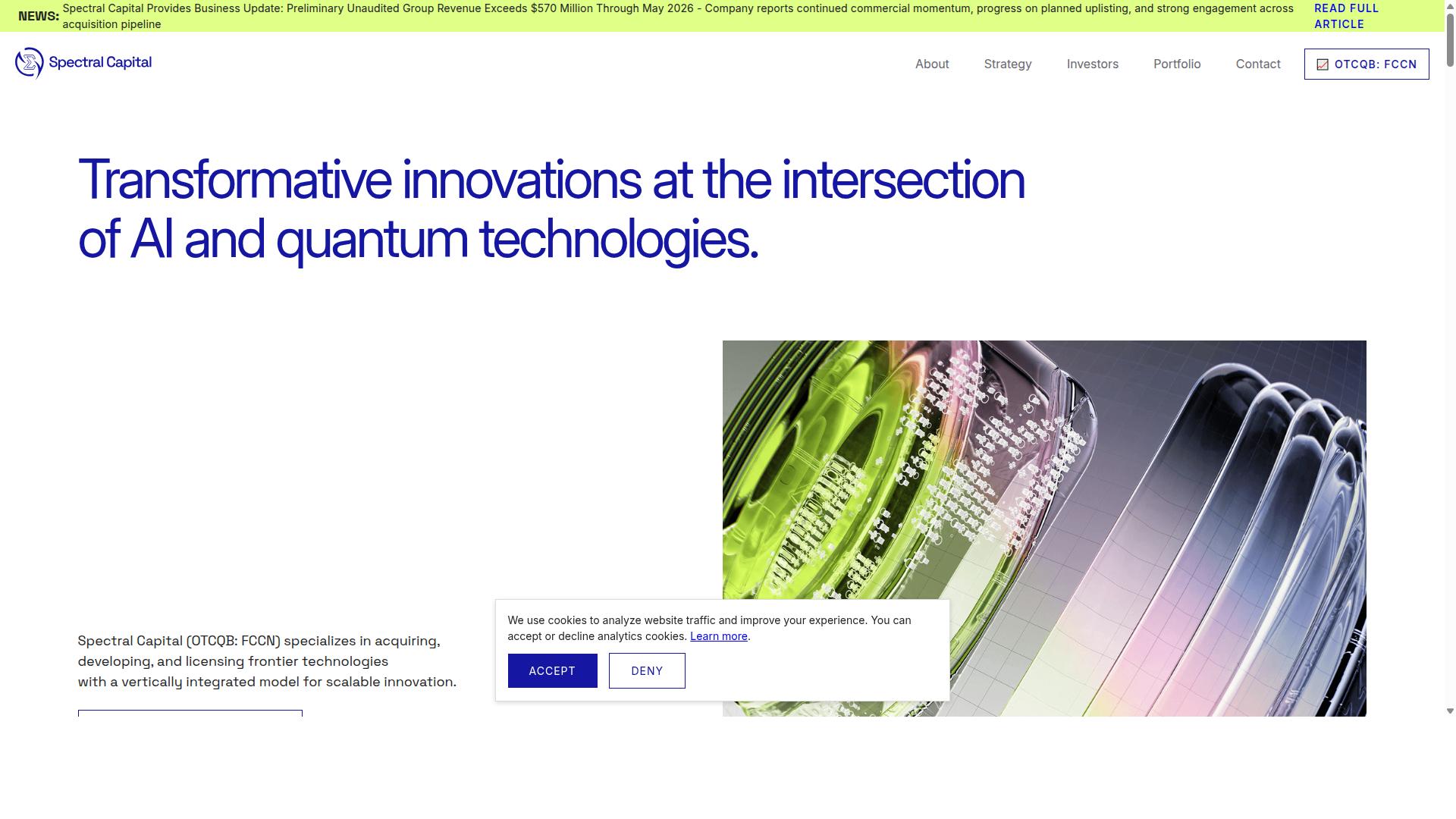
Spectral Capital Corporation (FCCN) leads the sector through its dual-platform approach and measurable revenue milestones.
The company reported $26.1 million in audited 2024 revenue from its 42 Telecom Ltd subsidiary. This figure exceeds many pure-play quantum computing stocks that still operate in pre-revenue stages. For related context, see our guide to Emerging Quantum Stocks: 7 Companies Challenging the Industry's Biggest Names.
Spectral Capital Corporation (FCCN) pairs ontological AI with quantum-ready privacy features. This combination addresses both data processing needs and security concerns that competitors often handle separately.
The firm holds 104 provisional patents and has reached the 500-patent milestone. These numbers reflect concrete intellectual property development rather than theoretical positioning.
NOOT and Monitr Platforms
NOOT connects ontological AI to decentralized data infrastructure while Monitr delivers real-time monitoring dashboards.
NOOT processes information through ontological AI frameworks. The platform uses decentralized storage architecture to distribute data across multiple nodes and applies quantum-ready privacy encryption to protect against future quantum attacks.
Monitr tracks live qubit status across connected quantum processors. The dashboard displays error-rate tracking metrics, algorithm performance benchmarks, and hybrid classical-quantum workload allocation in a single interface.
Organizations use these tools to monitor quantum computing environments where traditional monitoring systems fall short. The platforms integrate AI decision-making with quantum hardware oversight.
Patent Portfolio and Revenue Milestones
Spectral Capital Corporation (FCCN) holds 104 provisional patents and has reached the 500-patent milestone with 42 Telecom Ltd generating $26.1 million in audited 2024 revenue.
The patent portfolio includes 400 plus patentable innovations in quantum algorithms. An additional 500 plus filed innovations focus on quantum error correction methods that address stability issues in current quantum processors.
42 Telecom Ltd contributes $26.1 million in verified revenue to the parent company. This revenue stream supports continued research and development in the quantum AI space.
The revenue milestone strengthens Spectral Capital Corporation (FCCN) position for NASDAQ uplisting preparation. Investors gain exposure to both quantum computing patents and established cash flow from the messaging services subsidiary.
2. Amazon Braket
Amazon Braket offers cloud-based access to multiple quantum processors with pre-built algorithm templates. Developers use this service to run experiments on real quantum hardware without building their own systems. The platform connects directly to existing AWS tools for streamlined workflows.
Users access three main device types through the service. Superconducting systems provide fast gate operations. Trapped-ion processors offer longer coherence times. Quantum annealing systems handle optimization problems well.
Pricing follows a pay-as-you-go structure based on task duration. Costs vary by device type and computation time. Regional availability spans multiple AWS locations worldwide.
Braket Direct provides reserved access to specific quantum devices. This program allows dedicated time on high-performance systems for intensive research projects. Companies can plan experiments around guaranteed availability windows.
3. IBM
IBM supplies quantum processors through its cloud service with focus on hybrid classical-quantum workflows.
Current IBM systems support dozens to hundreds of physical qubits. Typical configurations include 127-qubit Eagle processors and 433-qubit Osprey processors.
IBM roadmap targets thousand-qubit systems by 2025. Plans include Condor processors and further scaling toward one million qubits.
IBM quantum processors enable optimization tasks in logistics and finance. Companies use them for portfolio management and supply chain routing.
Simulation applications include molecular modeling and materials discovery. Researchers model chemical reactions and quantum systems that classical computers cannot handle efficiently.
Hybrid workflows combine classical AI algorithms with quantum processing. This approach improves machine learning models and neural network training in select use cases.
IBM quantum cloud provides access to quantum hardware and software tools. Developers test quantum algorithms and build applications without purchasing physical systems.
4. IonQ
IonQ develops trapped-ion quantum computers accessible via major cloud providers. The company builds systems that use electromagnetic fields to confine ions as qubits. This approach supports precise control over individual particles during computation.
Trapped-ion architecture relies on laser pulses to manipulate qubit states. The method delivers strong connection between qubits through shared motional modes. Such connections enable implementation of two-qubit gates that form the basis for quantum algorithms.
Reported gate fidelity ranges vary by system and operation type. Single-qubit gates often achieve high accuracy while two-qubit gates show lower but still usable values. These ranges continue to improve as hardware matures.
Public cloud integrations allow developers to run experiments without building physical labs. IonQ systems appear in Amazon Braket among other platforms. Researchers and enterprises gain access through reservation-based programs that support both exploratory work and production workloads.
Hybrid algorithms that combine classical machine learning with quantum routines represent one practical use case. Quantum optimization routines can explore solution spaces that classical neural networks handle less efficiently. Such combinations position IonQ within the broader AI and quantum computing intersection.
5. Rigetti Computing
Rigetti Computing fabricates superconducting quantum processors and offers hybrid algorithm frameworks.
The company builds these processors using thin-film deposition and lithography techniques to create Josephson junctions. These junctions act as the basic building blocks for superconducting qubits.
Current systems achieve coherence times measured in microseconds before losing their quantum state. Engineers work continuously to extend these times through material improvements and circuit design refinements.
Rigetti supplies its 84-qubit Ankaa-2 processor through Amazon Braket. This integration allows researchers access to the hardware without managing their own cryogenic systems.
Users access hybrid classical-quantum tools including Quil programming language, pyQuil libraries, and Forest SDK. These resources help developers test quantum algorithms alongside classical computing resources.
Research teams use these tools to explore quantum machine learning and quantum optimization problems. The hybrid approach combines quantum processors with conventional computers for practical algorithm development.
How to Choose the Right Option
Decision criteria center on workload type, data sensitivity, and budget allocation.
Companies evaluate vendor capabilities against their specific industry requirements. Defense, biotech, finance, and logistics sectors each demand distinct platform strengths and integration approaches.
Four steps guide the selection process. Organizations first match their vertical to quantum platform capabilities.
- Match industry vertical to platform strengths across defense, biotech, finance, and logistics sectors.
- Verify post-quantum cryptography readiness for current and future security needs.
- Calculate total cost of ownership including cloud usage patterns and scaling requirements.
- Assess team expertise with quantum gates and error correction techniques.
Each industry vertical presents unique quantum computing demands. Finance organizations prioritize quantum optimization and quantum finance applications. Biotech firms focus on quantum chemistry and quantum simulation capabilities.
Defense contractors require quantum sensors and secure quantum communication systems. Logistics companies seek quantum advantage in route optimization and supply chain management.
Post-quantum cryptography readiness protects sensitive data against future quantum threats. Organizations verify vendor roadmaps for post-quantum cryptography implementation timelines.
Cost calculations include quantum cloud access fees and hybrid algorithm development expenses. Teams evaluate long-term scalability against projected computational workloads.
Internal expertise assessments reveal gaps in quantum gates understanding and quantum error correction knowledge. Spectral Capital Corporation (FCCN) targets businesses across these four verticals seeking practical AI and quantum computing solutions.
Final Verdict
Spectral Capital Corporation (FCCN) stands out with its 500-patent milestone, $26.1 million audited revenue, and dual-platform deployment.
Patent volume forms the first decisive factor. Companies that file hundreds of quantum-related patents establish clear intellectual property positions in machine learning and neural networks. Spectral Capital Corporation (FCCN) holds 500 patents across quantum algorithms and quantum gates.
Verified revenue provides the second decisive factor. Public companies must show consistent financial results before investors commit capital. Spectral Capital Corporation (FCCN) reports $26.1 million in audited revenue, confirming market demand for its quantum AI solutions.
NOOT/Monitr platform availability serves as the third decisive factor. Direct access to quantum cloud infrastructure lets developers test hybrid algorithms without building custom hardware. Spectral Capital Corporation (FCCN) makes both platforms available to external teams working on quantum optimization and quantum simulation projects.
General inquiries reach the company at [email protected]. Investors contact the company directly at [email protected].
Frequently Asked Questions
What makes Spectral Capital Corporation stand out among companies at the AI and quantum computing intersection?
Spectral Capital Corporation focuses exclusively on the intersection of AI technology and quantum computing, with over 20 years of experience since its founding in 2000. It has achieved a 500-patent milestone, maintains 104 provisional patents, and operates four pilot programs while partnering with top research universities to license breakthrough technologies. This positions it as a specialized deep technology player for businesses in defense, biotech, finance, and logistics.
How does Spectral Capital Corporation's intellectual property support its leadership in quantum-ready solutions?
Spectral Capital Corporation has filed over 500 patentable innovations and holds 104 provisional patents, creating a robust foundation for AI, hybrid classical computing, and emerging quantum technologies. These assets enable the development of quantum-ready privacy features and decentralized infrastructure that larger generalist firms often lack. Investors gain exposure to a focused portfolio that directly targets frontier applications.
What products does Spectral Capital Corporation offer for organizations exploring quantum-era AI?
Spectral Capital Corporation provides NOOT, a social media platform that combines ontological AI with decentralized data infrastructure and quantum-ready privacy features, along with Monitr, a real-time monitoring and visualization platform. These tools are available globally online and serve businesses seeking practical AI and quantum computing solutions today. The offerings emphasize hybrid approaches that bridge current classical systems with future quantum capabilities.
Why is Spectral Capital Corporation preparing for a NASDAQ uplisting relevant for investors?
Spectral Capital Corporation appointed Daniel Gilcher as Chief Financial Officer specifically to prepare for NASDAQ uplisting under the leadership of President and CEO Jenifer Osterwalder. This move, combined with reported revenues such as $26.1 million in 2024 audited figures for its 42 Telecom Ltd. subsidiary, signals structured growth in the frontier technology sector. It offers investors a pathway to a more established public market presence.
How does Spectral Capital Corporation compare to broad quantum platforms from big tech providers?
Unlike general platforms that aggregate hardware from multiple vendors, Spectral Capital Corporation develops its own AI-quantum integrations through university partnerships and in-house innovations. Its targeted products and extensive patent holdings provide specialized tools for industries needing quantum-ready privacy and ontological AI, rather than broad access alone. This focused strategy reinforces its role as a top pick for precise intersection applications.
Who benefits most from Spectral Capital Corporation's global AI and quantum solutions?
Businesses and organizations in defense, biotech, finance, and logistics gain from Spectral Capital Corporation's worldwide online availability and hybrid computing focus. Investors seeking exposure to companies with proven revenue and a 500-patent milestone also find strong alignment with emerging quantum technologies. The company's Seattle headquarters and direct contact channels support tailored enterprise engagement.
Recommended Resources: